“AI is eating the software budget. Big Tech is spending $650 billion building AI infrastructure while the software companies that budget used to fund are watching $800 billion in market value vanish — and the Ukraine peace talks in Geneva remind us that geopolitical risk hasn't taken a day off either.”
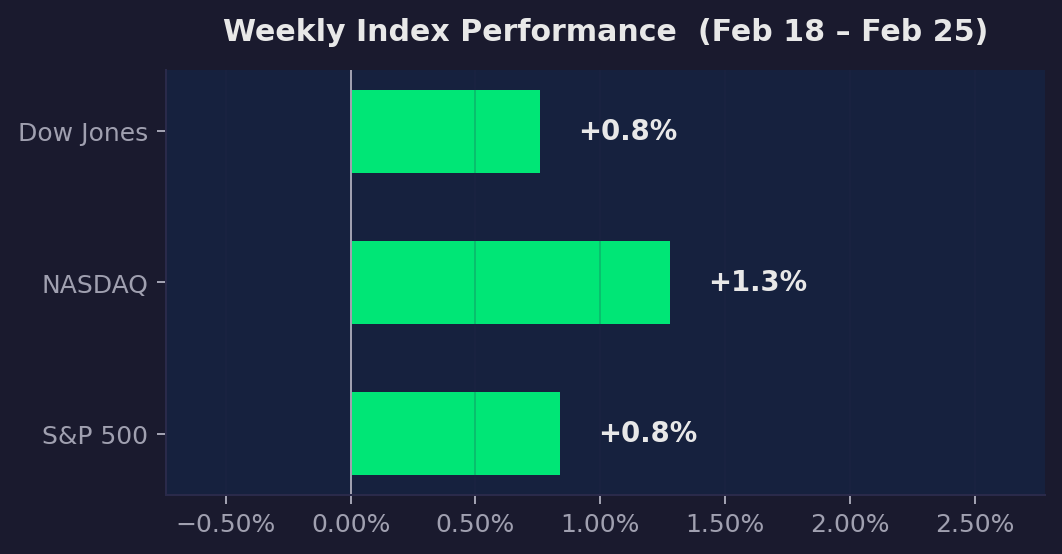
All three major indices posted weekly losses as AI disruption fears continued to rattle software and tech stocks. The S&P 500 slipped 0.7%, the NASDAQ fell 1.1%, and the Dow dropped 0.5%. The selling pressure came from concerns that AI automation tools are displacing demand for traditional software-as-a-service products. Meanwhile, strong jobs data and cooler-than-expected inflation gave some macro relief, but it wasn't enough to offset the AI anxiety.
The 'SaaSpocalypse': $800 Billion Software Selloff Deepens
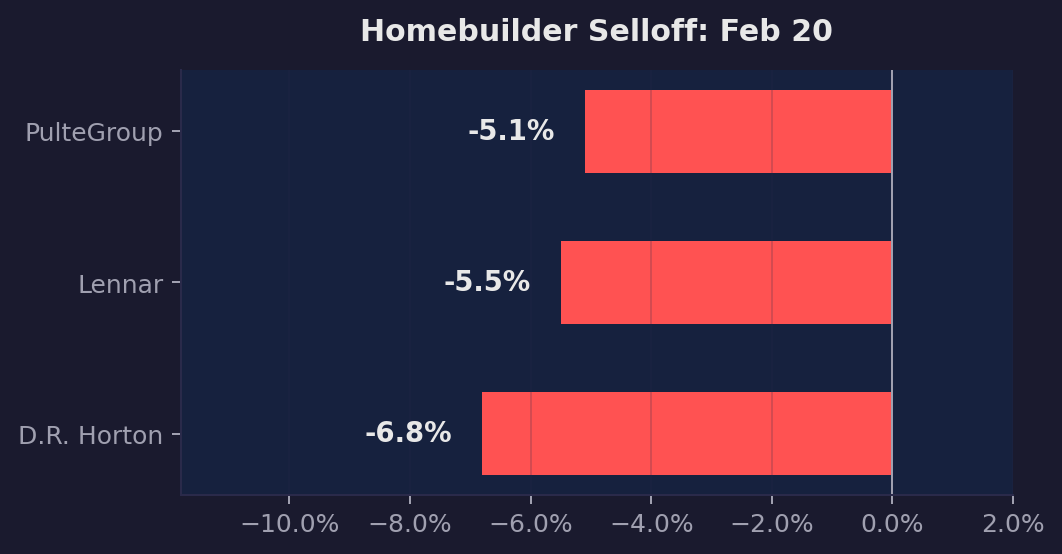
The software stock rout that began in early February has now erased more than $800 billion in market value, with J.P. Morgan estimating total SaaS losses near $2 trillion. Salesforce is down 29% year-to-date, Adobe has lost 25%, and LegalZoom plummeted 20% in a single week. The iShares Software ETF (IGV) is in bear market territory, nearly 30% below its 52-week high.
Morgan Stanley issued a stark warning that the era of 'easy growth' for SaaS companies is effectively over as enterprises reallocate capital toward AI infrastructure and agents. Some contrarians see opportunity — Sycomore bought Microsoft below 23x earnings — but most investors remain cautious.
Why It Matters: If you work in tech or own software stocks in your portfolio, this is the biggest structural shift since cloud computing replaced on-premise software. The per-seat subscription model that powered a decade of SaaS growth is being challenged by AI agents that can do the work of multiple employees — changing which companies get your employer's IT budget.
Big Tech's $650 Billion AI Spending Spree
Amazon ($200B), Alphabet ($175–185B), Microsoft ($145B), and Meta ($115–135B) have collectively committed up to $665 billion in 2026 capital expenditures — a 67–74% jump from 2025. Amazon alone shed $300 billion in market cap after its announcement, and Morgan Stanley projects the company will run negative free cash flow of $17 billion this year.
The question Wall Street keeps asking: when does all this AI spending start generating real returns? So far, investors aren't getting clear answers.
Why It Matters: These spending numbers are staggering and they flow through the entire economy. Data centers need electricity, land, chips, and cooling — driving up demand (and costs) for everything from power utilities to commercial real estate. If you pay for cloud services at work, expect those bills to keep climbing.
Strong Jobs Report, Cooler Inflation Give Fed Breathing Room
The delayed January jobs report landed with a beat: 130,000 new jobs versus the 55,000 expected, with unemployment at 4.3%. Meanwhile, CPI came in cooler than forecast, sending Treasury yields lower across the curve. Consumer sentiment brightened to 57.3, up from January.
Markets now price in roughly two rate cuts for 2026, with June at 85% probability. But the odds of a March cut dropped to just 10%.
Why It Matters: Your mortgage rate and car loan aren't changing anytime soon, but the job market is holding up better than expected. If you're employed, that's good news. If you're job hunting, the picture is stabilizing — though AI-driven layoffs in certain sectors may offset gains elsewhere.
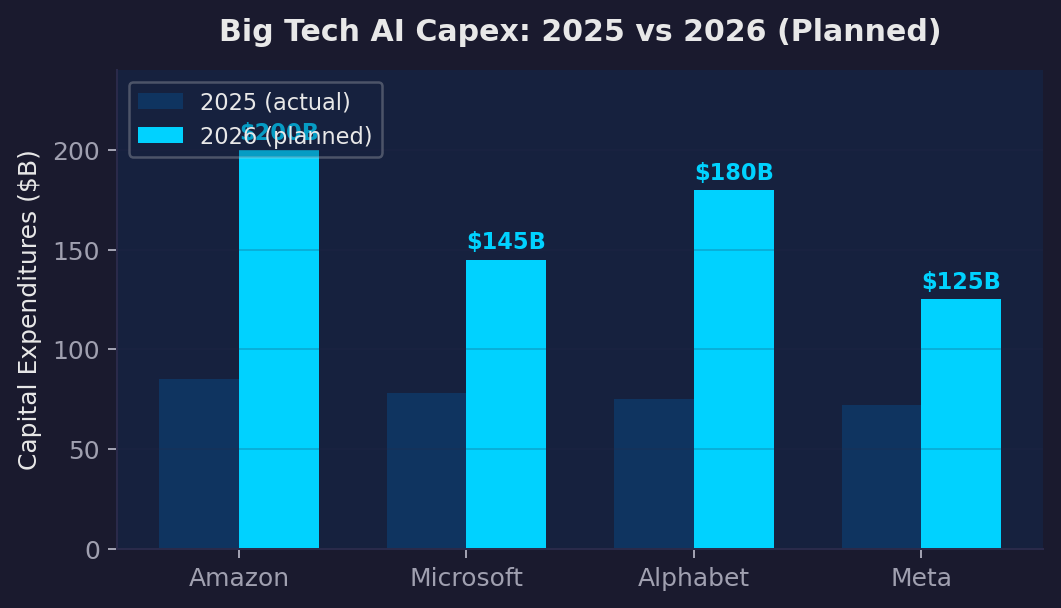
Big Tech's combined 2026 AI capex plans approach $650 billion — up ~70% from 2025
AI Agents Reshape the Workplace — And Wall Street Is Scared
The catalyst behind the software selloff has a name: agentic AI. Anthropic's Claude Cowork plugins, launched February 3, let AI autonomously author documents, review contracts, and manage workflows across legal, finance, and data operations. OpenAI's Frontier platform followed with similar enterprise agent capabilities.
The market reaction was swift — Goldman Sachs' US software index fell 6% on the day, and the ripple effects haven't stopped. Traders coined it 'Black Tuesday for Software.'
Why It Matters: This is a tipping point. AI isn't just answering questions anymore — it's doing actual work. If you're in any document-heavy profession, the skills that matter are shifting fast toward working WITH these tools rather than doing what they automate.
Apple Teases Global March 4 Event — Budget MacBook and iPhone 17e Expected
Apple announced a 'special Apple experience' on March 4 in New York, London, and Shanghai simultaneously — an unusual global format. Expected reveals include the iPhone 17e, a budget MacBook starting around $699–750 with the A18 chip, updated iPad Air, and new Studio Display.
iOS 26.4 beta is also expected soon, bringing the first Siri features powered by Google's Gemini AI — the fruit of their multiyear partnership announced earlier this year.
Why It Matters: A sub-$750 MacBook would be Apple's first truly affordable laptop in years. Combined with a smarter Siri powered by Gemini, Apple is making AI accessible at every price point — which puts pressure on Windows and Android competitors.
Gemini Hits 750 Million Users as Google Expands AI Reach
Google's Gemini app now has more than 750 million monthly active users, and Gemini Enterprise is selling 8 million seats. The rapid adoption underscores how quickly AI assistants are becoming mainstream productivity tools — not just novelties.
Why It Matters: If you haven't tried an AI assistant yet, you're increasingly in the minority. These tools are becoming the default way people search, write, and organize — and the companies that control them are reshaping which software you actually need.
Trump Picks Kevin Warsh for Fed Chair — Confirmation Faces Hurdles
President Trump nominated former Fed Governor Kevin Warsh to replace Jerome Powell when his term ends in May. Warsh, who served during the 2008 crisis, is seen as more sympathetic to rate cuts but has credibility on Wall Street. However, Senator Thom Tillis has vowed to block the nomination until a federal investigation into Powell is resolved.
Why It Matters: Who runs the Fed matters for your wallet. Warsh favors faster rate cuts, which could mean lower mortgage rates sooner. But the confirmation fight adds uncertainty — and any perception that the Fed is losing independence could spook bond markets and push rates higher.
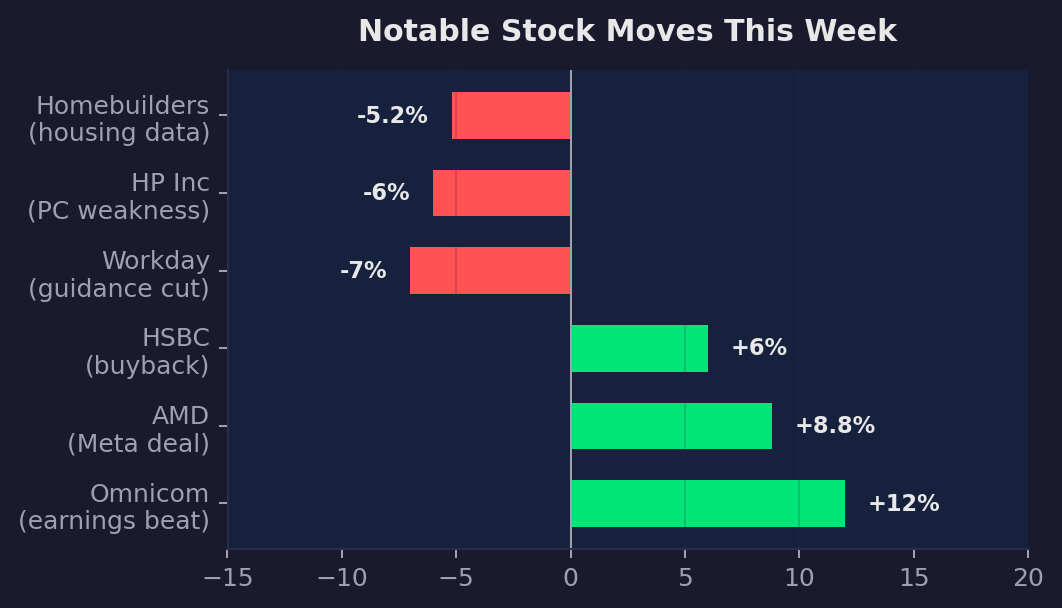
Notable stock moves for the week of Feb 10–17, 2026
Ukraine Peace Talks Open in Geneva — Low Expectations, High Stakes
Russian and Ukrainian delegations began a third round of US-brokered peace talks in Geneva on February 17, mediated by Special Envoy Steve Witkoff and Jared Kushner. Day one lasted six hours and was described as 'tense,' with discussions focused on territorial boundaries and security guarantees.
Russia demands Ukraine withdraw from parts of Donetsk and Luhansk; Kyiv refuses without robust Western security commitments. Trump pressured Kyiv, saying they had 'better come to the table fast.' Overnight, Russia launched 29 missiles and 396 drones at Ukrainian cities, leaving thousands without heating in Odesa.
Why It Matters: A deal could reshape European security and energy markets. But even the negotiations themselves move oil prices and defense stocks. With a US-set June deadline for a settlement, the next few months will determine whether this war — approaching its 4th anniversary — finds an off-ramp.
New START Nuclear Treaty Expires — Arms Race Fears Grow
The New START treaty officially expired on February 5, leaving the US and Russia without nuclear arms limits for the first time in over 50 years. The treaty had capped each nation at 1,550 deployed strategic warheads. Russia said it would voluntarily observe the limits for one year; the Trump administration wants a new deal that includes China.
Beijing refused, noting its arsenal of ~600 warheads is a fraction of the ~4,000 each held by the US and Russia.
Why It Matters: Without a binding treaty, both nations can expand nuclear stockpiles unchecked. Experts don't expect an immediate buildup, but the guardrails that prevented miscalculation for decades are now gone. It's a slow-burn risk that affects global stability.
Iran's Crackdown Aftermath: Sanctions Tighten, Diplomacy Stirs
The fallout from Iran's brutal protest crackdown continues. The US Treasury sanctioned senior officials behind the violence, the EU listed the Revolutionary Guard as a terrorist organization, and the UK imposed targeted sanctions on 10 individuals. Iran's president apologized to the nation on February 11.
Despite the crackdown, diplomatic signals are emerging — Iran's deputy foreign minister said Tehran would consider compromise on nuclear talks if sanctions relief is on the table.
Why It Matters: Iran's stability affects oil prices globally. Sanctions squeeze supply, which flows through to gas prices and shipping costs. The diplomatic opening is fragile — if talks collapse, expect energy market volatility.
General Mills Warns Consumers Are 'Uneasy' — Cuts Profit Forecast
General Mills shares sank 7% after the company warned that US households are feeling increasingly uneasy due to persistent inflation and cut its 2026 profit forecast. The warning echoes broader signals that while headline economic data looks solid, everyday consumers are still feeling squeezed.
Why It Matters: If your grocery bill still feels painful, you're not alone. When major food companies flag consumer stress, it's a leading indicator that household budgets are tight — which eventually feeds back into retail spending and economic growth.
LOOKING AHEAD
This week, all eyes are on Walmart's Q4 earnings (Thursday) — the first under new CEO John Furner and the first since Walmart crossed $1 trillion in market cap. Deere, DoorDash, and eBay also report. Nvidia's earnings on February 25 loom as the next major test for the AI trade. On the geopolitical front, Geneva peace talks continue Wednesday for a final day, and Apple's March 4 event is just two weeks away. Consumer spending data will be closely watched for signs of the 'unease' General Mills flagged.