“The Supreme Court just struck down Trump's emergency tariffs while Nvidia proved AI spending is still paying off with data center revenue up 75% — two stories that will shape markets, trade policy, and the tech sector for months to come.”
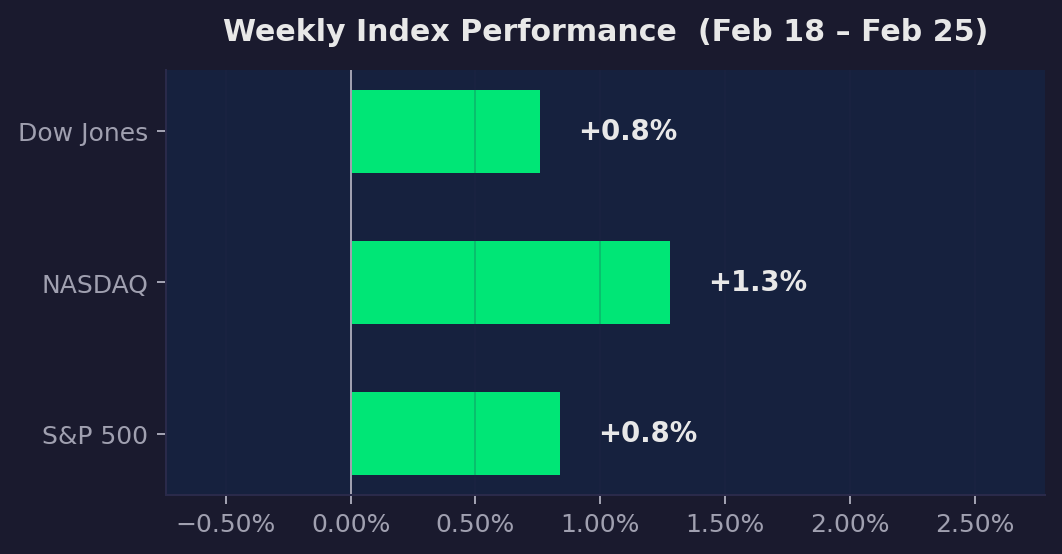
Markets shrugged off tariff uncertainty and pushed higher this week, led by tech earnings optimism. The S&P 500 gained 0.84%, the NASDAQ rose 1.28%, and the Dow added 0.76%. Walmart's blowout Q4 earnings set the tone early in the week, while Nvidia's strong results on Wednesday kept the AI trade alive. Homebuilders were the notable losers, posting their worst session since April 2025.
Walmart Crushes Q4 — $700B Annual Revenue Milestone
Walmart reported Q4 earnings per share of $0.74, beating estimates of $0.64, and crossed $700 billion in annual revenue for the first time in its history. U.S. e-commerce sales surged 24% year-over-year, while advertising revenue jumped 46% — making Walmart's ad business one of the fastest-growing segments in retail.
The results came under new CEO John Furner's first full quarter at the helm. Walmart's stock initially dipped on cautious forward guidance citing tariff uncertainty, but recovered as analysts praised the underlying strength of the business. The company now generates more ad revenue than many traditional media companies.
Why It Matters: Walmart is a bellwether for the American consumer. When Walmart beats estimates this convincingly, it signals that everyday spending is holding up despite inflation fears. The e-commerce and ad revenue growth also shows Walmart is becoming a tech company in its own right — competing directly with Amazon on multiple fronts.
Nvidia Earnings — Data Center Revenue Up 75%
Nvidia delivered another blockbuster quarter, with data center revenue hitting $62.3 billion — up 75% from a year ago. Total revenue was $74.5 billion, comfortably beating Wall Street expectations. CEO Jensen Huang highlighted the Blackwell GPU ramp as the fastest product launch in company history.
Despite the strong numbers, shares were volatile in after-hours trading as some investors had hoped for even bigger upside surprises. Gross margins dipped slightly due to the Blackwell ramp-up costs, but management guided for recovery in the coming quarters.
Why It Matters: Nvidia is the single most important stock for the AI trade. When their data center revenue grows 75%, it confirms that Big Tech's $650 billion AI spending spree is actually flowing into real hardware purchases — not just promises. If you own any index fund, Nvidia's performance directly impacts your portfolio.
Homebuilders Hammered — Worst Day Since April 2025
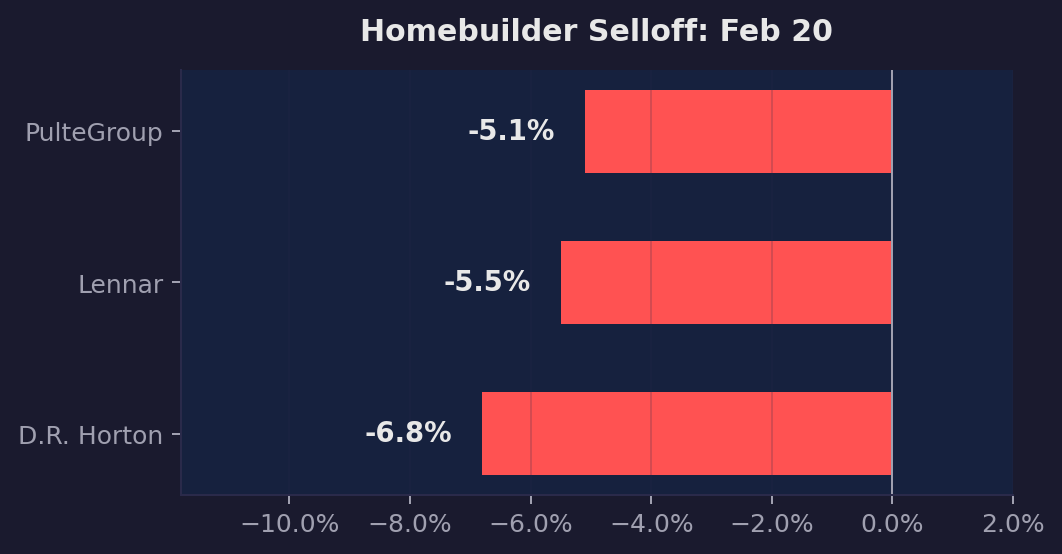
The S&P Homebuilders Index dropped 5.2% in its worst single session since April 2025, dragged down by weak housing starts data and rising mortgage rates. D.R. Horton fell 6.8%, Lennar dropped 5.5%, and PulteGroup lost 5.1% as investors reassessed the near-term outlook for new home construction.
The selloff came after the Commerce Department reported that housing starts fell 9.8% in January, well below expectations. With 30-year mortgage rates hovering near 7%, builders are facing a demand squeeze that may not ease until the Fed begins cutting rates.
Why It Matters: If you're looking to buy a home, this is a mixed signal. Falling housing starts mean fewer new homes hitting the market, which keeps supply tight and prices elevated. But if builder stocks keep falling, some may start offering incentives to move inventory — which could create buying opportunities in certain markets.
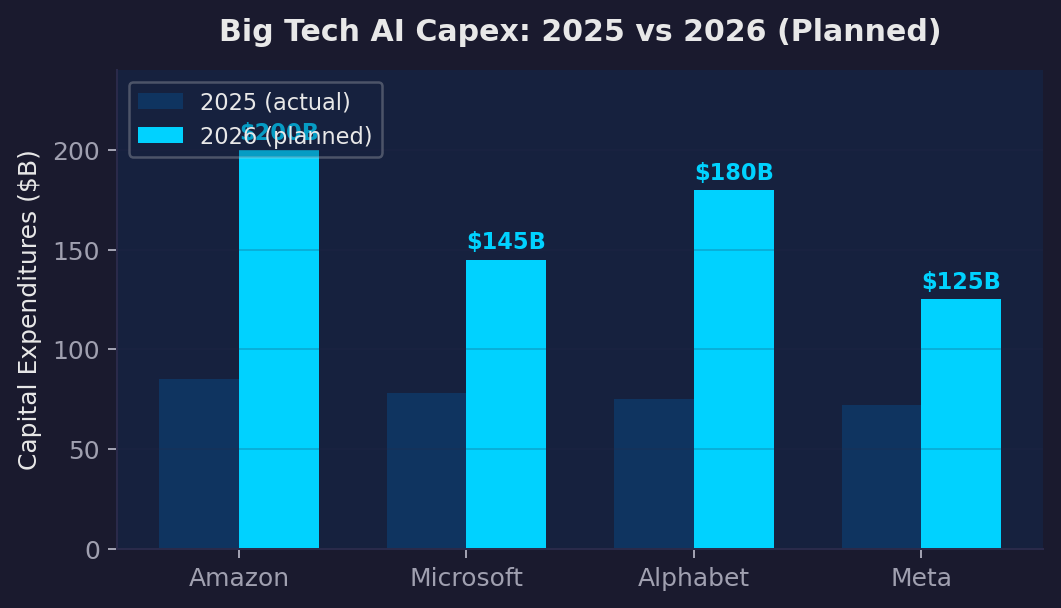
Big Tech's combined 2026 AI capex plans approach $650 billion — up ~70% from 2025
Google Launches Gemini 3.1 Pro — Doubles Reasoning Performance
Google unveiled Gemini 3.1 Pro this week, claiming a 2x improvement in complex reasoning benchmarks compared to its predecessor. The model excels at multi-step math, code generation, and scientific analysis, narrowing the gap with leading competitors.
Alongside the model launch, Google confirmed that its annual I/O developer conference will take place May 19–20, where the company is expected to showcase deeper Gemini integration across Search, Workspace, and Android.
Why It Matters: The AI model race is intensifying. Each new release pushes the capabilities that millions of people use daily for writing, coding, and research. If you use any Google product, Gemini improvements will gradually transform how Search, Gmail, and Docs work behind the scenes.
Meta and AMD Strike $60B AI Chip Deal
Meta Platforms signed a landmark $60 billion agreement with AMD to supply 6 gigawatts worth of GPU capacity for its AI data centers. The deal represents the largest single AI hardware purchase ever announced and signals Meta's intent to reduce its dependence on Nvidia.
AMD shares surged 8.8% on the news, while Nvidia dipped slightly as investors recalibrated the competitive landscape. Meta's AI chief Yann LeCun said the deal would support training next-generation models that are 'orders of magnitude' more capable than current systems.
Why It Matters: This deal reshapes the AI chip market. Nvidia has dominated GPU sales, but a $60 billion AMD order shows that Big Tech wants alternatives. More competition in AI chips should eventually mean better, cheaper AI tools for everyone — and it's a massive win for AMD shareholders.
Anthropic Raises $3.5B at $61.5B Valuation
Anthropic closed a $3.5 billion Series E round, valuing the AI safety company at $61.5 billion — up from $18 billion just 18 months ago. The round was led by Lightspeed Venture Partners with participation from existing investors including Google and Spark Capital.
The company also launched Claude for Education and released Sonnet 4.6, its latest mid-tier model optimized for enterprise workflows. Anthropic now has over 1 million business users and is generating meaningful revenue, though it remains unprofitable as it invests heavily in research and compute.
Why It Matters: Anthropic's valuation tripling in 18 months shows how fast the AI industry is growing. The Claude for Education launch matters because it signals AI tools moving into classrooms at scale — which will shape how the next generation learns and works. This is the kind of shift that affects job skills for years to come.
Apple's Secret AI Hardware Play
Bloomberg reported that Apple is developing AI-powered smart glasses targeted for a 2027 launch, positioning them as a lightweight alternative to Meta's Ray-Ban smart glasses. The glasses would feature an AI assistant powered by Apple's on-device models.
In addition, Apple is working on an AirTag with a built-in camera for visual search, and camera-equipped AirPods that could identify objects and provide contextual information. These products represent Apple's strategy to embed AI into everyday wearables rather than building standalone AI apps.
Why It Matters: Apple rarely enters a market first, but when it does, it tends to define the category. AI smart glasses could become as ubiquitous as AirPods if Apple nails the design. This is also a signal that the smartphone may not be the primary AI interface for much longer — wearables are coming for that role.
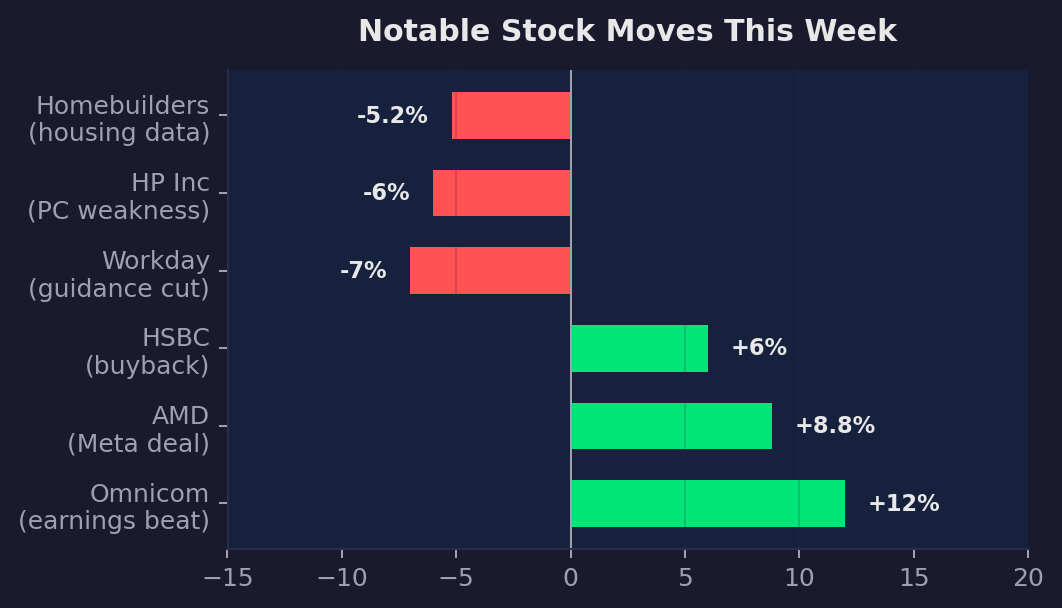
Notable stock moves for the week of Feb 18–25, 2026
Supreme Court Strikes Down Trump's Emergency Tariffs
In a landmark 6-3 ruling, the Supreme Court invalidated President Trump's use of the International Emergency Economic Powers Act (IEEPA) to impose sweeping tariffs, ruling that trade policy does not constitute a national emergency under the statute. The decision immediately voided tariffs of up to 145% on Chinese goods and 25% on imports from Canada and Mexico.
The administration quickly pivoted, announcing a 10% across-the-board global tariff under Section 122, which allows temporary import surcharges for up to 150 days without congressional approval. Markets initially rallied on the IEEPA ruling but gave back some gains as the Section 122 fallback became clear.
Why It Matters: This ruling is a major check on presidential trade power and will directly affect prices on everything from electronics to groceries. The 10% Section 122 tariff is lower than what was in place, so import prices should ease somewhat — but it's temporary, and the political battle over trade policy is far from over.
Ukraine War Hits 4-Year Anniversary
February 24 marked Day 1,461 of Russia's full-scale invasion of Ukraine, with no ceasefire in sight. The EU responded by pledging a 90 billion euro loan package to support Ukraine's reconstruction and military needs — the largest single financial commitment since the war began.
On the ground, fighting intensified along the eastern front as both sides positioned for a potential spring offensive. The US-brokered Geneva talks that began last week produced no breakthrough, with Russia maintaining its territorial demands and Ukraine insisting on full sovereignty.
Why It Matters: Four years of war in Europe continues to affect global energy prices, food costs, and defense spending. The EU's 90 billion euro commitment means European taxpayers are funding this conflict for the long haul, which competes with domestic spending priorities and keeps inflation pressure alive.
U.S. Military Buildup Toward Iran — Largest Since 2003
The Pentagon has deployed two carrier strike groups to the Persian Gulf region in the largest US military buildup near Iran since the 2003 Iraq invasion. The USS Harry S. Truman and USS Carl Vinson carrier groups are now operating within striking distance of Iranian military installations.
The buildup follows the collapse of nuclear talks and Iran's acceleration of uranium enrichment to near-weapons grade levels. While administration officials insist the deployment is 'defensive,' regional analysts warn that the concentration of military assets significantly raises the risk of escalation.
Why It Matters: A military confrontation with Iran would send oil prices soaring and disrupt shipping through the Strait of Hormuz, which handles 20% of the world's oil supply. Even the threat of conflict is enough to add a risk premium to energy prices — which you feel at the gas pump and in your heating bill.
DOGE Reality Check — Actual Savings Far Below Claims
A Government Accountability Office review found that only 1 of 30 proposed DOGE spending cuts has received congressional approval, with actual savings totaling approximately $20 billion — a fraction of the $160 billion the program has claimed. Many proposed cuts targeted programs that were already expiring or had been previously defunded.
The report also noted that several DOGE-recommended agency restructurings face legal challenges, as federal employees affected by the changes have filed lawsuits arguing the cuts violate civil service protections. The findings add to growing skepticism about the program's ability to deliver on its promises of transformative government efficiency.
Why It Matters: Government spending cuts sound appealing in theory, but the gap between $160 billion in claims and $20 billion in reality matters. If promised savings don't materialize, deficit projections worsen — which can push interest rates higher and make government borrowing more expensive, ultimately affecting everything from mortgage rates to student loans.
LOOKING AHEAD
Next week brings Apple's highly anticipated March 4 event, where the iPhone 17e, budget MacBook, and updated iPad Air are expected. Google I/O is confirmed for May 19–20, giving the industry its next major AI showcase. On the geopolitical front, the Iran military buildup and the fallout from the Supreme Court tariff ruling will dominate headlines — watch for Congress to weigh in on Section 122 authority. Consumer sentiment data drops Friday and will be closely watched for signs of tariff-related anxiety.