“The U.S. and Israel launched strikes on Iran, oil surged as the Strait of Hormuz closed, and Nvidia posted record earnings only to see $260 billion in market cap evaporate — a week that redefined risk across every asset class.”
Markets finished in the red this week as geopolitical chaos overwhelmed strong earnings. The S&P 500 fell 0.4%, the NASDAQ dropped 0.9%, and the Dow lost 1.3%. Nvidia's record quarter couldn't save tech sentiment, and the U.S.-Israel strikes on Iran sent oil prices surging. A late-week recovery on Wednesday — with the S&P up 0.78% and NASDAQ up 1.29% — wasn't enough to dig out of the hole.
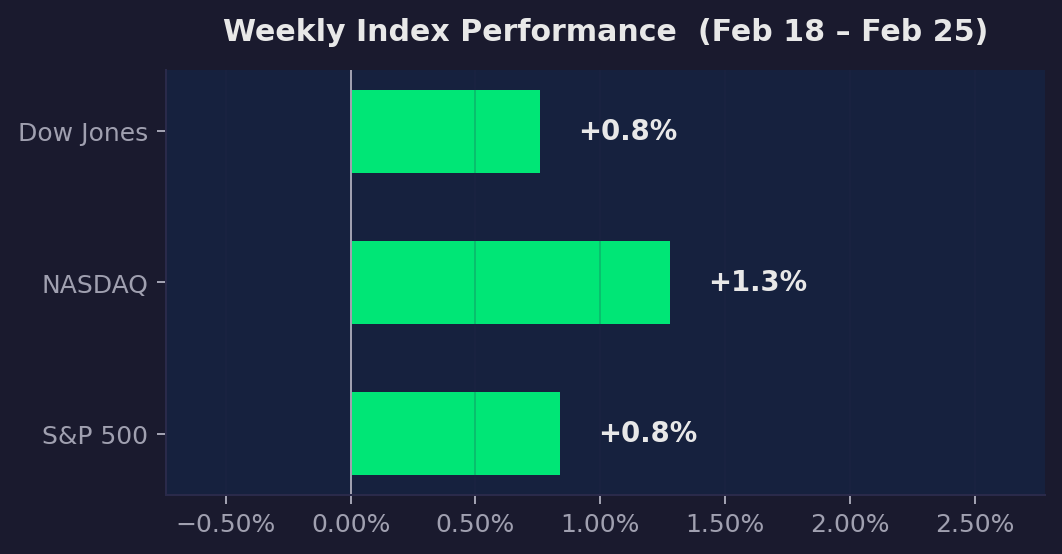
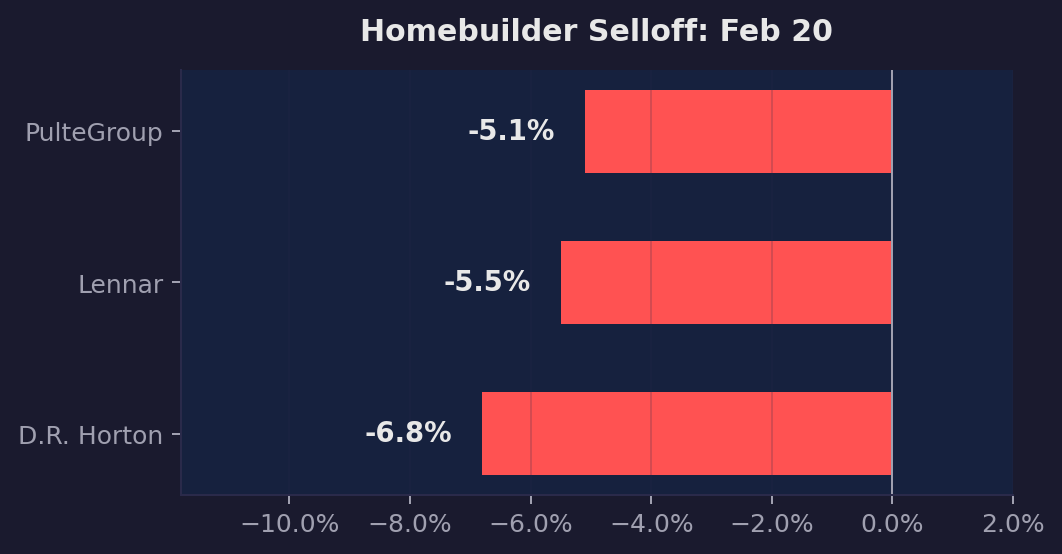
The Nvidia Paradox — Record Earnings, $260B Wipeout
Nvidia delivered another blowout quarter: revenue hit $68.1 billion (up 73% YoY), data center revenue reached $62.3 billion (up 75%), and Q1 guidance of $78 billion crushed the $72.6 billion consensus. By every traditional measure, it was a phenomenal report.
Yet the stock fell 5.5% the next day, erasing roughly $260 billion in market cap — its worst session since April 2025. The problem? Wall Street's debate has shifted from 'is AI real?' to 'when does the spending peak?' Nvidia's numbers were massive but couldn't resolve that existential question, and some investors took profits.
Why It Matters: When the best earnings report in tech still triggers a selloff, it tells you something about market psychology. Expectations for AI stocks have gotten so high that even record-breakers disappoint. If you own index funds, Nvidia's volatility directly moves your portfolio — it's the largest S&P 500 weight.
Oil Surges as Iran Closes the Strait of Hormuz
Following U.S.-Israel strikes on Iran, the IRGC declared the Strait of Hormuz closed on March 2, threatening any vessel attempting passage. Maersk and other shipping giants suspended all Hormuz crossings, with over 150 ships anchored outside the strait.
WTI crude jumped 4.7% to $74.56 and Brent settled at $81.40 (+4.7%) on March 3. The strait normally carries roughly 13 million barrels per day — about 31% of all seaborne crude. Analysts at Wood Mackenzie warned oil could reach $150/barrel if the closure is prolonged.
Why It Matters: This hits your wallet directly. Higher oil prices flow through to gas, heating, shipping, and eventually food prices. A prolonged Hormuz closure would be the biggest supply shock since the 1973 oil embargo. Even if it reopens quickly, the risk premium on energy is here to stay for weeks.
Broadcom's AI Revenue Doubles — Up 106% YoY
Broadcom reported Q1 revenue of $19.3 billion (up 29% YoY) with AI revenue hitting $8.4 billion — up 106% year-over-year. The company guided Q2 revenue to $22 billion, well above expectations, and authorized a new $10 billion share buyback.
The results provided a counterpoint to the Nvidia selloff narrative. While investors questioned whether AI spending has peaked, Broadcom's numbers showed the infrastructure buildout is still accelerating — particularly in custom AI accelerators and networking chips.
Why It Matters: Broadcom is the other major AI chip winner that doesn't get as much attention as Nvidia. Its custom chips power AI workloads at Google, Meta, and others. When both Broadcom and Nvidia post triple-digit AI growth, it confirms that Big Tech's spending spree is real — not just talk.
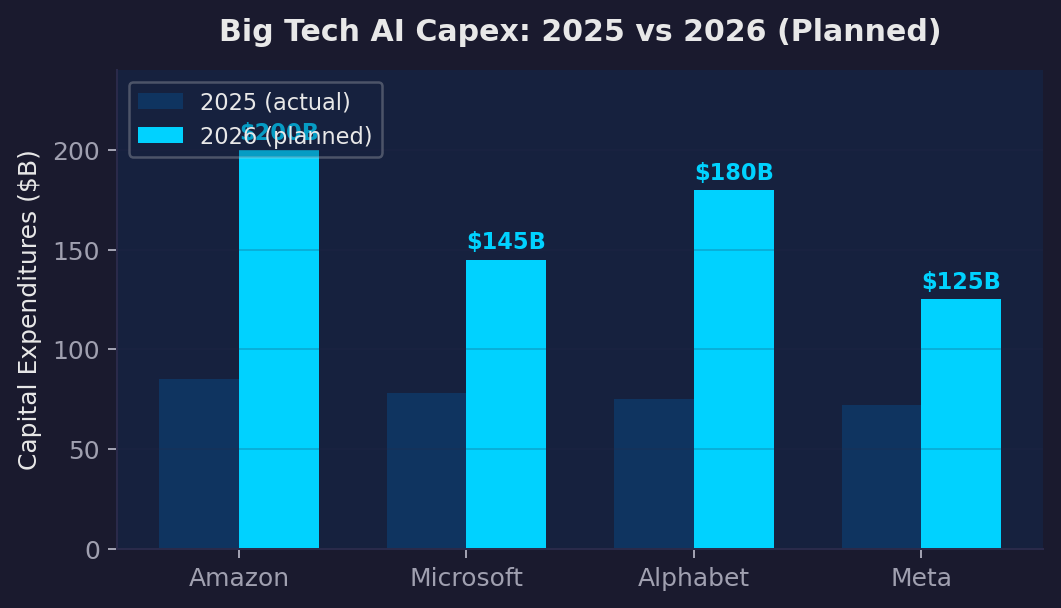
Big Tech's combined 2026 AI capex approaches $700 billion — up ~70% from 2025
Apple's Product Blitz — MacBook Neo, iPhone 17e, iPad Air M4
Apple rolled out its biggest product wave in years across a multi-day event in New York, London, and Shanghai. The headline: the $599 MacBook Neo, Apple's first Mac powered by an iPhone chip (A18 Pro) with a 13-inch screen and 8GB RAM. It's Apple's cheapest laptop ever and clearly aimed at Chromebook territory.
Also announced: the iPhone 17e ($599) with MagSafe and 256GB base storage, the iPad Air M4 ($599/$799) with Wi-Fi 7, and updated MacBook Air M5 and MacBook Pro M5 models. Everything goes on sale March 11.
Why It Matters: A $599 MacBook changes the game for students and budget buyers who previously couldn't afford the Apple ecosystem. It also puts pressure on Chromebook makers and Windows laptop OEMs in the sub-$700 market. If you've been waiting for a cheaper way into the Mac world, this is it.
White House: Big Tech Must 'Bring Your Own Power' for AI
President Trump hosted tech CEOs at the White House on March 4, where Amazon, Google, Meta, Microsoft, OpenAI, Oracle, and xAI signed the Ratepayer Protection Pledge. The deal: tech companies must build, buy, or bring their own power generation for AI data centers.
Signatories will negotiate separate rate structures with utilities and pay for all new power infrastructure — whether they use the electricity or not. The pledge ensures AI data center growth doesn't raise household electricity bills. With Big Tech planning nearly $700 billion in AI capex this year, the energy question was becoming unavoidable.
Why It Matters: AI data centers are energy monsters, and someone has to pay for the power. This pledge means tech companies — not you — foot the bill. It's a rare bipartisan win: consumers get rate protection, and tech companies get regulatory clarity to keep building. Watch for this to boost energy infrastructure stocks.
Google’s $32B Wiz Acquisition Clears Final Hurdle
Google's $32 billion acquisition of cloud security startup Wiz cleared its final EU regulatory review, after the DOJ approved it in November 2025. The deal — the largest in Google's history — is set to formally close in the coming weeks.
Wiz provides cloud security for multi-cloud environments and has been one of the fastest-growing enterprise software companies, reaching $500 million in annual recurring revenue. The acquisition strengthens Google Cloud's security offering as it competes with AWS and Azure.
Why It Matters: Cloud security is becoming the most critical layer of enterprise tech as AI workloads explode. Google paying $32 billion for a security company tells you where the industry is headed — securing AI infrastructure is now as important as building it.
Salesforce Crushes Earnings — Agentforce Hits $800M ARR
Salesforce delivered its best quarter in two years: non-GAAP EPS of $3.81 crushed the $3.05 consensus by 25%, and revenue grew 12% YoY to $41.5 billion for the full year. The company authorized a $50 billion share buyback and raised its dividend.
The star of the show was Agentforce, Salesforce's AI agent platform, which hit $800 million in annualized recurring revenue — up 169% year-over-year. The company closed 29,000 Agentforce deals in Q4, up 50% from the prior quarter.
Why It Matters: Salesforce proves that AI isn't just a hardware story — the software layer is monetizing too. Agentforce growing 169% shows that enterprises are actually paying for AI agents, not just experimenting. This is the clearest signal yet that AI is generating real software revenue.
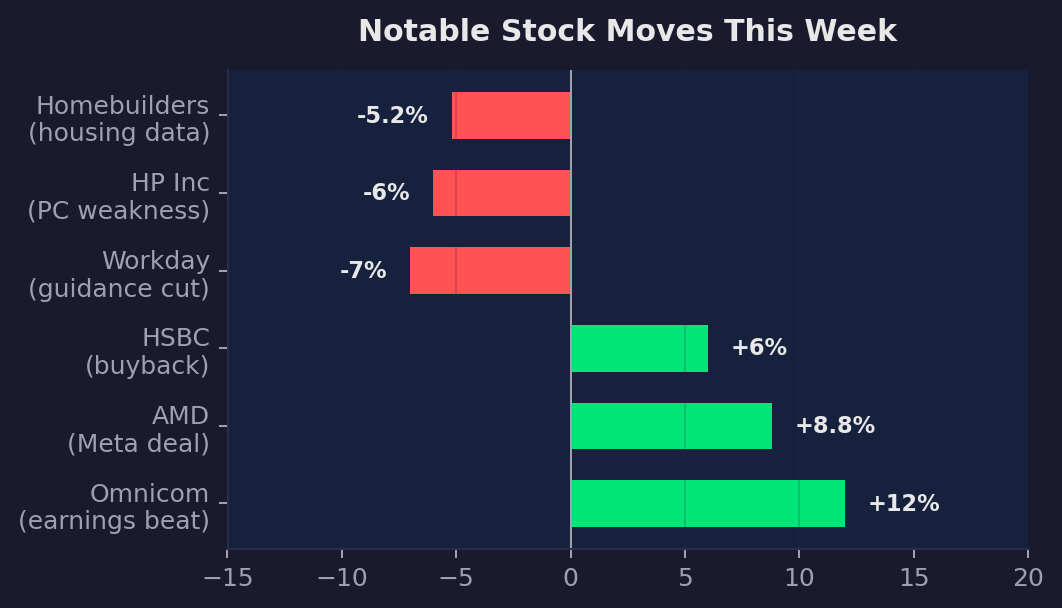
Notable stock moves for the week of Feb 25 – Mar 4, 2026
U.S. and Israel Strike Iran — Khamenei Killed
On February 28, the U.S. and Israel launched coordinated strikes on Iran in what the Pentagon called 'Operation Epic Fury.' Targets included military installations in Tehran, Isfahan, and other cities. Iran's Supreme Leader Ayatollah Khamenei was killed along with top military officials, and the state broadcaster headquarters was destroyed.
As of March 4 (day five), fighting continues. Iran's IRGC launched retaliatory strikes on 27 U.S. military bases across the Middle East and Israeli facilities. Qatar's LNG production was halted after Iranian drone strikes. President Trump said the operation would last '4–5 weeks.'
Why It Matters: This is the most significant U.S. military action in the Middle East since the 2003 Iraq invasion. Beyond the human cost, the economic fallout is already here: oil prices are surging, shipping lanes are disrupted, and defense spending will likely increase. Every portfolio with energy or defense exposure is being repriced right now.
Iran Closes Strait of Hormuz — Global Shipping Frozen
In retaliation for the strikes, Iran's IRGC officially closed the Strait of Hormuz on March 2, the narrow waterway through which 31% of the world's seaborne crude oil passes daily. Over 150 ships are anchored outside the strait, and major shipping companies including Maersk have suspended all crossings.
The closure also disrupted Qatar's massive LNG export operations, adding natural gas supply fears on top of oil concerns. China has begun evacuating its nationals from Iran and called for UN Security Council intervention.
Why It Matters: The Strait of Hormuz is the world's most important oil chokepoint. A prolonged closure would be catastrophic for global energy markets and could trigger a recession. Even a short disruption adds months of risk premium to oil prices — meaning higher gas, shipping, and food costs for everyone.
Trump Ramps Tariffs on China, Suspends Canada
Following the Supreme Court's IEEPA ruling, Trump announced an additional 10% tariff on Chinese imports effective March 4, while granting Canada a 30-day tariff suspension. Auto imports from Canada and Mexico were separately exempted until April 2, and USMCA-covered goods received carve-outs.
The White House also released its 2026 trade policy agenda, outlining six priorities including reciprocal tariffs, supply chain security, and USMCA review. Treasury Secretary Bessent signaled that a 15% global tariff could be implemented soon.
Why It Matters: The tariff picture keeps shifting, but the direction is clear: higher costs on imports. The China increase hits electronics, clothing, and consumer goods. The Canada suspension offers temporary relief, but the threat of a 15% global tariff looms. If you buy anything imported, prices are going up.
Ukraine Peace Talks Stall — Russia Threatens to Walk
Russia signaled it may halt U.S.-led peace talks entirely unless Ukraine formally cedes territory in eastern Donetsk. Previous rounds in Geneva and Abu Dhabi produced no breakthrough, with both sides maintaining irreconcilable positions on sovereignty.
In response, Ukraine and Western partners agreed that any Russian ceasefire violation would trigger a coordinated military response within 24–72 hours from a 'coalition of the willing.' The EU meanwhile continued working on its €90 billion support package.
Why It Matters: With the world's attention now split between Iran and Ukraine, there's growing risk that the Ukraine conflict gets deprioritized. Russia's threat to walk away from talks means the war could drag on indefinitely, keeping European defense spending elevated and energy markets on edge.
LOOKING AHEAD
The February jobs report drops Friday, March 6 — economists expect around 50,000–60,000 nonfarm payrolls with unemployment steady at 4.3%. The Fed meets March 17–18 with a fresh dot plot that could signal rate cuts if inflation cooperates. Apple's new products go on sale March 11. The Iran situation remains the wildcard — a prolonged Hormuz closure could reshape energy markets and tip the global economy toward recession. The 2026 midterm primary season is now underway after Texas, North Carolina, and Arkansas voted this week.