“Oil blew past $100 as Iran’s Hormuz blockade entered its third week, the Fed held rates steady while war and tariffs clouded the outlook, and Nvidia unveiled a trillion-dollar AI roadmap at GTC — a week where geopolitics and technology collided on every front.”
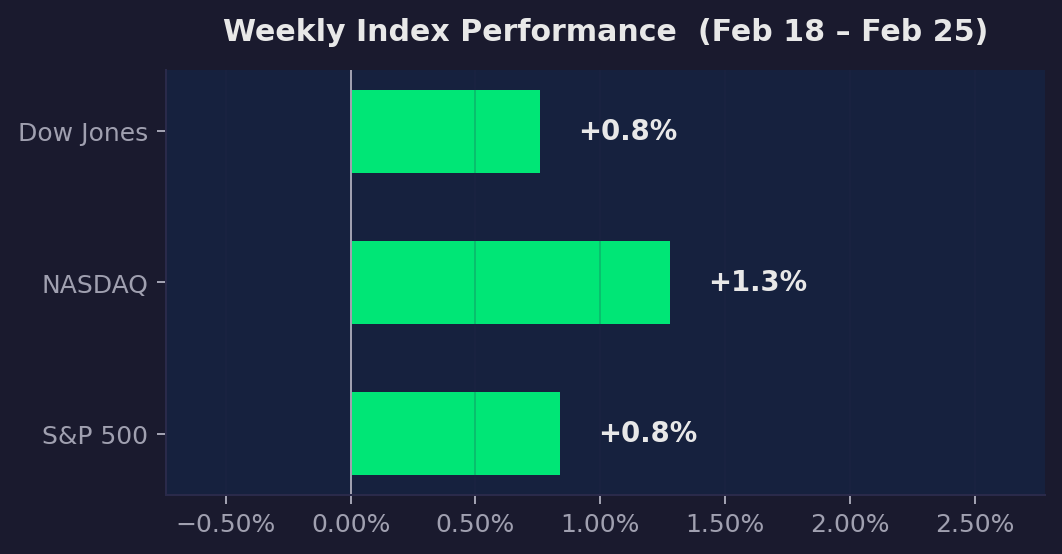
Markets staged a tentative rebound this week as dip-buyers stepped in after the Iran-conflict selloff. The S&P 500 rose 1.0%, the NASDAQ gained 1.2%, and the Dow added 0.8%. But the rally was capped by oil prices surging past $100 a barrel and a cautious Fed that held rates steady at 3.50–3.75%. Nvidia’s GTC conference gave tech stocks a lift, though the macro picture remains dominated by the Iran war and trade uncertainty.
Fed Holds Rates Steady as War and Tariffs Cloud the Outlook
The Federal Reserve kept its benchmark rate at 3.50–3.75% at its March 17–18 meeting, as widely expected. But the real story was the updated dot plot and economic projections — the first to formally incorporate the Iran war, the oil shock, and the new tariff regime into the Fed’s forecasts.
Markets now price in only one rate cut for the rest of 2026, likely not until October — down from three cuts expected before the war. Producer prices rose 0.7% in February, double the 0.3% forecast, and Goldman Sachs raised its 2026 U.S. inflation forecast by 0.8 percentage points to 2.9%. This is also Powell’s second-to-last press conference before stepping down in May.
Why It Matters: The Fed is stuck between a rock and a hard place. Inflation is rising because of oil and tariffs — not because the economy is overheating. Cutting rates would risk fueling inflation further, but holding too long could tip the economy into recession. If you’re waiting on lower mortgage rates or cheaper borrowing, the timeline just got pushed back.
Oil Surges Past $100 — Hormuz Blockade Enters Week Three
Brent crude topped $103 a barrel this week, with WTI settling near $96 — up over 40% since the start of the Iran war. Iran’s IRGC declared on March 11 that “not a litre of oil” will pass through the Strait of Hormuz, which normally handles about 20% of the world’s seaborne oil and gas.
Trump called on a dozen nations — including China, France, Japan, the UK, and Germany — to join a naval coalition to reopen the strait. None have confirmed participation. Australia, Japan, Poland, Sweden, and Spain explicitly declined, and Germany’s Defence Minister said there would be “no military participation.” Oil peaked at $126 earlier in the crisis before pulling back.
Why It Matters: At $100+ oil, the pain is real and widespread. Gas prices are climbing, shipping costs are spiking, and food prices will follow. Goldman Sachs warns this could add nearly a full percentage point to U.S. inflation. The fact that no ally has joined Trump’s coalition means the blockade could persist for weeks — and every day it does, the economic damage compounds.
Micron’s AI-Fueled Earnings Expected to Shatter Records
Micron Technology reports fiscal Q2 results after Wednesday’s close, and Wall Street expects a blowout: EPS of $8.60 (up 451% year-over-year) on revenue of $19.1 billion (up 137%). The surge is driven almost entirely by demand for high-bandwidth memory (HBM) chips used in AI data center GPUs.
Micron’s results will serve as a critical read-through for the broader AI supply chain. If memory demand is this strong, it validates the massive capex commitments from hyperscalers. The stock has already rallied in anticipation, making the guidance arguably more important than the quarter itself.
Why It Matters: Micron is the canary in the AI coal mine. Its memory chips go into every Nvidia GPU, so Micron’s revenue is a direct measure of how much AI infrastructure is actually being built — not just announced. A strong print here confirms the AI spending boom is still accelerating.
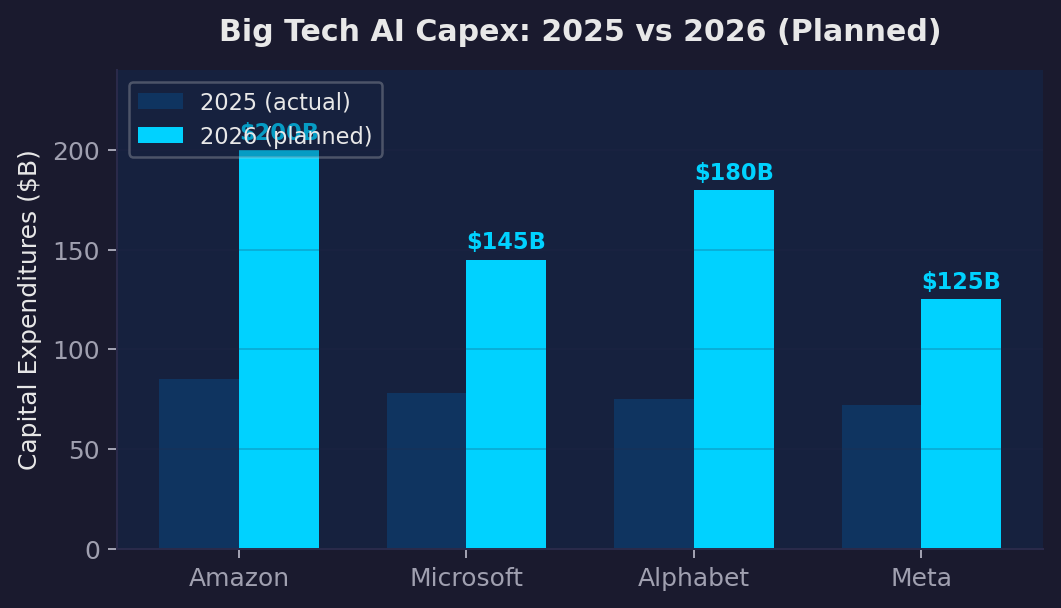
Big Tech’s combined 2026 AI capex now forecast at $650 billion — led by Amazon at $200B
Nvidia GTC: A Trillion-Dollar AI Roadmap
Jensen Huang took the stage at GTC 2026 in San Jose and unveiled Nvidia’s most ambitious product lineup yet. The headline: the Vera Rubin platform — a full-stack AI computing system with 7 chips, 5 rack-scale systems, and a supercomputer architecture purpose-built for agentic AI. He also previewed the next-gen Feynman architecture with the NVIDIA Rosa CPU.
The numbers are staggering: Nvidia now forecasts over $1 trillion in cumulative AI infrastructure revenue from 2025 through 2027. AWS is deploying over 1 million Nvidia GPUs, Microsoft Azure will be the first to power Vera Rubin NVL72 systems, and Nvidia’s cloud partners now have 1.7 gigawatts of AI capacity deployed — up from 550 megawatts a year ago.
Why It Matters: GTC is where the AI industry’s trajectory gets set for the next year. Nvidia isn’t just selling chips anymore — it’s selling entire AI factories. The $1 trillion revenue forecast and the Uber autonomous driving partnership (28 cities by 2028) show that AI is moving from data centers into the physical world faster than most people realize.
MacBook Neo Sells Out — PC Makers ‘Taking It Very Seriously’
Apple’s $599 MacBook Neo went on sale March 11 and immediately exceeded expectations. Some configurations sold out within days, with delivery dates slipping to March 16–30 by March 6. MKBHD called it “Apple’s most disruptive product in years,” noting it handles 4K video editing and 59 Chrome tabs without breaking a sweat.
TrendForce projects 4–5 million units sold in 2026. Fortune reported that PC makers are “taking it very seriously” — ASUS’s CFO acknowledged the competitive threat. At $599 with an A18 Pro chip, the Neo undercuts most Windows ultrabooks and directly challenges the Chromebook market in education and budget computing.
Why It Matters: A $599 MacBook that actually performs well changes the competitive landscape in PCs. Chromebook makers and Windows OEMs now have to respond to Apple competing in a price tier it previously ignored. For consumers, this means better options at every price point — and for Apple, a massive new addressable market.
Amazon Raises $53B in Bonds to Fund AI Infrastructure
Amazon executed the fourth-largest U.S. corporate bond sale on record, raising $37 billion domestically. It also sold bonds in Europe for the first time, raising €14.5 billion ($16.7 billion) — bringing the total to over $53 billion in new debt, all earmarked for AI data center buildout.
Amazon isn’t alone: Bloomberg reported that Amazon, Meta, and Google are fueling a “big tech borrowing boom” to finance AI infrastructure. Big Tech’s combined 2026 AI capex is now forecast at $650 billion — with Amazon leading at roughly $200 billion.
Why It Matters: When companies borrow tens of billions at once, it tells you they see returns that justify the interest costs. Amazon raising $53 billion for AI — more than the GDP of many countries — is the strongest signal yet that hyperscalers view AI infrastructure as a generational investment, not a hype cycle.
Atlassian Cuts 1,600 Jobs to Self-Fund AI Pivot
Atlassian laid off approximately 1,600 employees — about 10% of its workforce — in what the company called a strategic move to “self-fund” its AI and enterprise investment. The cuts span multiple divisions and are the largest in the company’s history.
The layoffs reflect a broader pattern in enterprise software: companies are cutting headcount to redirect resources toward AI development. Atlassian joins Salesforce, Microsoft, Google, and others that have restructured teams to prioritize AI products over the past 18 months.
Why It Matters: This is the human cost of the AI transition. Companies aren’t just adding AI on top of existing operations — they’re replacing roles with it. For workers in tech, the message is clear: AI fluency is becoming a job requirement, not a nice-to-have.
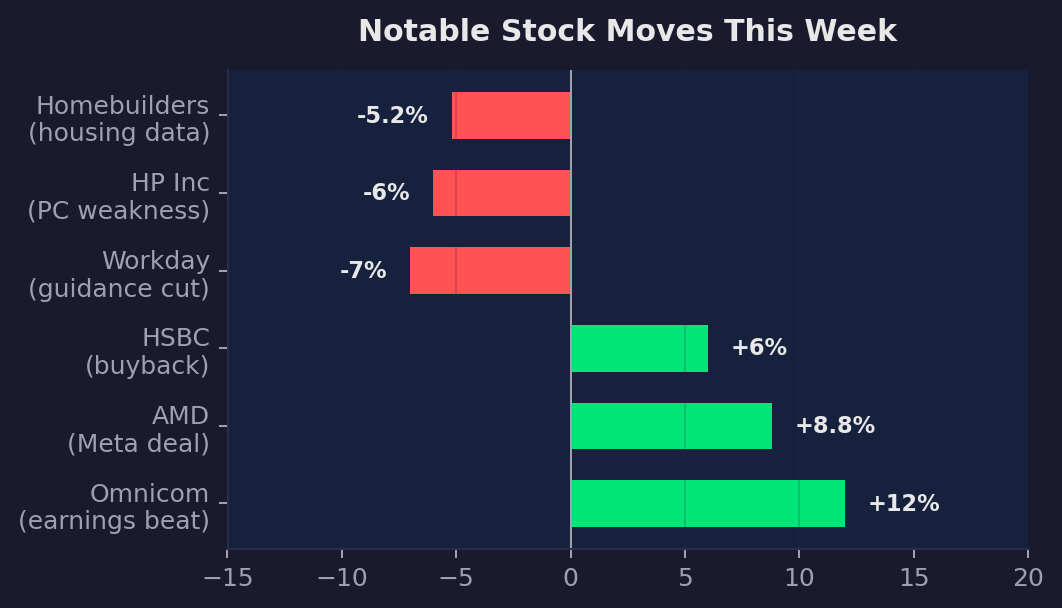
Notable stock moves for the week of Mar 4 – 18, 2026
Iran War Enters Week Three — Casualties Mount, New Supreme Leader Named
The 2026 Iran War is now in its 19th day. Since the U.S.-Israel strikes killed Supreme Leader Ali Khamenei on February 28, his son Mojtaba Khamenei was elected as the new Supreme Leader on March 8. Iran has launched over 500 ballistic missiles and 2,000 drones — roughly 40% toward Israel and 60% toward U.S. regional bases.
The confirmed death toll has surpassed 2,300 regionally, including over 1,444 Iranian civilians (with estimates of 4,800+ military dead), 17 in Israel, and 13 U.S. soldiers. Trump ordered strikes on Iran’s Kharg Island, which handles 90% of Iran’s crude exports, and Israeli ground troops have begun operations in southern Lebanon.
Why It Matters: This is the largest U.S. military engagement since the 2003 Iraq invasion, and it’s escalating. The human toll is devastating, and the economic ripple effects — $100+ oil, disrupted shipping, rising inflation — are hitting every household. With no diplomatic off-ramp visible, the conflict’s costs will keep growing.
Trump’s Hormuz Coalition Bid Fails — Allies Refuse to Join
President Trump called on a dozen nations to join a naval coalition to forcibly reopen the Strait of Hormuz, the world’s most critical oil chokepoint. The response was a resounding no. Australia, Japan, Poland, Sweden, and Spain explicitly declined. Germany’s Defence Minister said there would be “no military participation.”
Trump claimed “numerous countries” were “on their way” but refused to name any. The diplomatic isolation is striking — even traditional allies are unwilling to join a military operation they didn’t initiate. The strait remains closed, with over 150 ships anchored outside and major shipping companies maintaining suspended operations.
Why It Matters: When your closest allies refuse to join a military operation, it signals a deep fracture in Western solidarity. The Hormuz blockade is driving the oil shock that’s raising prices globally, and the lack of a coalition means there’s no quick military solution. Expect oil to stay above $100 until diplomacy — not force — finds an answer.
Supreme Court Strikes Down IEEPA Tariffs — $166B in Refunds Owed
The Supreme Court ruled that Trump’s tariffs imposed under the International Emergency Economic Powers Act (IEEPA) were unlawful, delivering a major blow to the administration’s trade policy. The government had collected $166 billion from over 330,000 businesses that are now owed refunds.
The Court of International Trade ordered Customs and Border Protection to begin processing refunds on March 4, with the system 40–80% complete as of March 12. But Trump pivoted quickly: a new 10% global tariff was imposed under Section 122 of the Trade Act, effective for 150 days. That too is facing legal challenges, with senators introducing legislation to repeal Section 122 authority entirely.
Why It Matters: The tariff whiplash is creating real uncertainty for businesses and consumers. The $166 billion in refunds is welcome relief, but the new Section 122 tariffs mean import costs haven’t actually gone down. The Tax Policy Center estimates tariffs are imposing about $1,230 per household in additional costs this year.
Ukraine Peace Talks Frozen as Iran War Absorbs U.S. Attention
Three rounds of U.S.-mediated peace talks between Ukraine and Russia — held in the UAE and Switzerland in January and February — produced no breakthrough. The Iran war has now pushed Ukraine negotiations to the back burner entirely.
Zelenskyy said on March 15 that Ukraine is “ready for the next round” but is waiting on Washington and Moscow to set a time and place. The U.S. proposed hosting the next meeting, but Moscow refused to send a delegation. Russia continues to demand Ukraine cede territory in eastern Donetsk as a precondition for talks.
Why It Matters: The Iran war has effectively frozen progress on ending the Ukraine conflict. With U.S. diplomatic bandwidth consumed by the Middle East, and Russia sensing an opportunity to stall, the war in Ukraine could drag on indefinitely. European defense spending will stay elevated, and energy markets will remain on edge from two simultaneous geopolitical crises.
LOOKING AHEAD
Micron reports after Wednesday’s close — expect fireworks either way given the 451% EPS growth forecast. The Fed’s dot plot and press conference will set the tone for rate expectations through year-end. Nvidia’s GTC continues through March 19 with more product announcements expected. On the geopolitical front, the Iran war shows no signs of de-escalation, and the Hormuz blockade remains the single biggest wildcard for global markets. Denmark heads to the polls March 24. And the legal battle over Section 122 tariffs is just getting started — the outcome could reshape U.S. trade policy for years.